| Pests | |||||||
 |
|||||||
 |
"For heavens's
sake - a bug!"
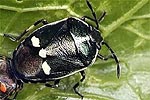
Pictures of bugs, found in the garden or in the house, are often shown to entomologists, especially when the animals occur in high numbers. The questions put to them concern besides the names of the species also if they are injurious or dangerous. Nearly none are. Most bug species, as most other insects, live in special habitats, not noticed by men. In Central Europe, a few species can be pests or become annoying because of their disagreeable smell when invading houses in autumn. But they don't cause any damage in food stores for example. Only little damage is caused by the large pentatomide species (Aelia, Carpocoris) in agriculture. In tropical and subtropical countries many bug species however are serious pests in plant cultures. For example, small species of the family Tingidae occur in masses. That may be seen in South and Central Europe, where a North American tingide species, Corythucha ciliata, damages the leaves of plane trees (Platanus). Occasional stings as defence reactions by large assassin bugs (Reduviidae) or back-swimemrs (Notonecta) are really painful but not really dangerous, but one should be very cautious in touching them. |
||||||
|
Bugs in the garden
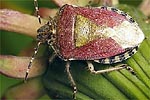
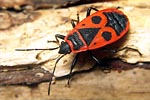
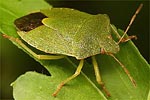
Well known not only by entomologists, Pyrrhocoris apterus, a cotton stainer bug, occurs everywhere in the vicinity of lime trees (Tilia) or of mallow (Malvaceae), on which they feed. Their marked red colour with two striking black spots on the wings gave rise to their German name fire bugs. Large Pentatomidae as Dolycoris baccarum, berry bug in German or the green Palomena prasina smear their stinking secretions on berries, making them evil smelling and tasting.
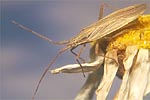
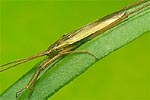
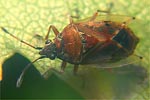
They are well known by many people. That is also true for the Lygaeidae Kleidocerys reedae, the 'birch bug'. It mostly occurs on birches in big crowds, its smell is awkward and it also invades human habitations in autumn. Some Miridae like Stenodema and Notostira species feed on grass and can occasionally cause damage in cereals.
|
||||||
|
Bugs in houses
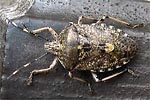
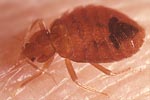
Some bug species invade houses in large quantities, looking for warm and dry places for over-wintering. Another prominent example is the Pentatomidae Rhaphigaster nebulosa. One knows cases of hundreds of individuals in a single room. A special case of dangerous and annoying bug is the parasitic, bloodsucking bedbug, Cimex lectularius. It sucks on birds and mammals, especially bats and humans. Its sting causes strong itching and allergic reactions in people. It is well known, inspite of the fact, that it has nearly disappeared in Central Europe as a result of high hygienic standards.
|
||||||
|